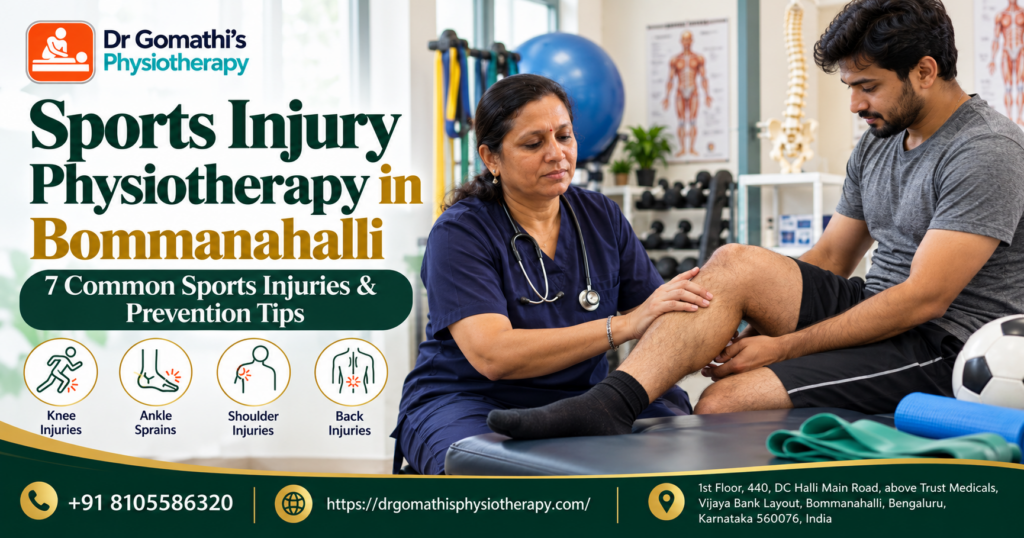
Sports Injury Physiotherapy in Bommanahalli: 7 Common Sports Injuries and How to Prevent Them
Sports Injury Physiotherapy · Bommanahalli Sports Injury Physiotherapy in Bommanahalli: 7 Common Sports Injuries and How to Prevent Them Discover common injuries affecting runners, athletes and active individuals. Learn practical prevention tips, when physiotherapy may help, and how rehabilitation supports a safer return to sport. Book Your Consultation Mon–Sat: 9 AM – 9 PM | Sun: 9 AM – 3 PM | +91 81055 86320 Can physiotherapy help you recover after a sports injury? In many cases, physiotherapy can support recovery by addressing pain-related movement limitations, rebuilding strength and helping people return to physical activities gradually. Whether you enjoy running, cricket, badminton, football, cycling or gym workouts, knowing how injuries happen can help you make informed decisions. If you are looking for sports injury physiotherapy in Bommanahalli , Dr.Gomathi’s Physiotherapy clinic provides physiotherapy and rehabilitation services in Bengaluru. Why Do Sports Injuries Happen? Sports injuries can affect anyone, from first-time gym members to experienced athletes. Some occur suddenly during a fall, awkward landing, collision or rapid change of direction. Others develop gradually when repeated activity places more demand on muscles, tendons or joints than they can currently tolerate. For example, a runner may develop discomfort after increasing weekly mileage too quickly. A badminton player may experience shoulder pain after repeated overhead movements without adequate recovery. Fatigue, previous injuries, inadequate conditioning, changes in training intensity and equipment-related factors can all influence injury risk. However, no single factor explains every injury. A proper assessment can help identify what may have contributed to the problem. 7 Common Sports Injuries and How to Prevent Them Different sports place different demands on the body. The following seven injuries are frequently encountered in running, court sports, team sports and recreational exercise. 1. Ankle Sprains An ankle sprain happens when one or more ligaments around the ankle are stretched or torn. It commonly occurs when the foot rolls unexpectedly during running, jumping, landing or changing direction. Football, basketball and badminton players may experience ankle sprains because their activities involve frequent turning and jumping. Common symptoms: Pain, swelling, tenderness, bruising and difficulty putting weight on the foot. Prevention tips: Improve ankle strength, practice single-leg balance, progress jumping and landing exercises gradually, and use suitable footwear. Physiotherapy approach: Depending on severity, rehabilitation may include swelling management, ankle mobility, progressive strengthening, balance exercises and sport-specific movement practice. 2. Hamstring Strains Hamstrings are muscles located along the back of the thigh. They play an important role in running, accelerating and controlling leg movement. A hamstring strain may occur during sprinting, sudden acceleration or forceful stretching beyond the muscle’s current capacity. These injuries are often associated with football, athletics and activities involving fast running. Common symptoms: Sudden pain behind the thigh, tenderness, weakness, difficulty running and sometimes bruising. Prevention tips: Build hamstring strength progressively, include suitable eccentric exercises, increase sprinting demands gradually and allow recovery. Physiotherapy approach: Rehabilitation may include controlled strengthening, gradual running progression and assessment of readiness for high-speed movement. 3. Knee Ligament Injuries Knee ligament injuries can happen during sudden twisting, unexpected landings, collisions or rapid changes in direction. The anterior cruciate ligament, commonly called the ACL, is one of the structures that may be injured. Sports such as football, basketball and other pivoting activities can place considerable demands on knee stability. Common symptoms: Sudden knee pain, swelling, a feeling of instability, difficulty walking or reduced movement. Prevention tips: Practice controlled landing mechanics, strengthen the hips and legs, develop balance and include structured neuromuscular training when appropriate. Physiotherapy approach: Rehabilitation may involve restoring movement, rebuilding lower-limb strength, improving balance and gradually progressing to sport-specific activities. Important: A suspected serious knee ligament injury requires medical assessment. Some injuries need specialist evaluation, imaging or surgery. Physiotherapy should be coordinated with the recommended medical plan. 4. Runner’s Knee (Patellofemoral Pain) Patellofemoral pain is a common cause of discomfort around or behind the kneecap. It may be associated with running, stair climbing, squatting or prolonged periods of sitting. Symptoms sometimes develop after changes in running distance, exercise intensity or training frequency. Common symptoms: Pain around the kneecap, discomfort when squatting, difficulty with stairs and pain after running. Prevention tips: Increase running loads progressively, strengthen the hips and quadriceps, vary training demands and allow sufficient recovery. Physiotherapy approach: Exercise-based rehabilitation may focus on knee and hip strengthening, activity modification and gradual return to running. 5. Achilles Tendinopathy The Achilles tendon connects the calf muscles to the heel bone. Achilles tendinopathy can develop when repeated running, jumping or other activities place excessive demands on the tendon. Runners and people who suddenly increase their training load may experience discomfort in this area. Common symptoms: Pain or stiffness near the heel or along the tendon, tenderness and discomfort during running or jumping. Prevention tips: Progress running and jumping gradually, develop calf strength and avoid sudden increases in training volume. Physiotherapy approach: Treatment may include progressive calf-loading exercises, activity modification and gradual return to higher-demand movements. Sudden severe pain with a popping sensation or difficulty pushing off the foot may indicate a tendon rupture and requires urgent assessment. 6. Tennis Elbow (Lateral Elbow Tendinopathy) Tennis elbow is a condition involving pain around the outer part of the elbow. Despite its name, it does not affect tennis players exclusively. It can also occur in people performing repetitive gripping or wrist movements. Racquet sports, certain gym exercises and repeated hand-intensive activities may contribute to symptoms. Common symptoms: Pain on the outer elbow, discomfort while gripping, reduced grip strength and pain during lifting. Prevention tips: Increase gripping loads gradually, use suitable equipment, improve forearm strength and manage repetitive activity. Physiotherapy approach: Rehabilitation may include progressive forearm strengthening, load management and advice for work or sports activities. 7. Rotator Cuff Injuries The rotator cuff is a group of muscles and tendons that helps control shoulder movement and stability. Shoulder problems may develop gradually through repeated overhead activity or suddenly after an injury. Badminton, swimming, cricket bowling, weight training and throwing sports place different demands on the shoulder. Common symptoms: Shoulder pain